

Building Timely Voter Registration Data Pipelines with Civis Platform
With November's midterms approaching, voter registration programs are scaling up across the country. Field teams are working hard to collect new registrations at community events, college campuses, and neighborhood canvasses. Digital teams are reaching out online to register voters and recruit volunteers. Data teams are responsible for making sure those registrations flow quickly into organizing systems, making new registrants available for volunteer recruitment, targeted persuasion, and GOTV efforts in a timely manner.
Your field team might collect registrations through Blocks, but your volunteer coordinators manage outreach in VAN. Every day that a new registrant sits in one system without flowing to the other is a missed opportunity to engage them while they're still excited about participating. Getting these systems to talk to each other has traditionally meant cobbling together manual exports, custom scripts, and a lot of hope.
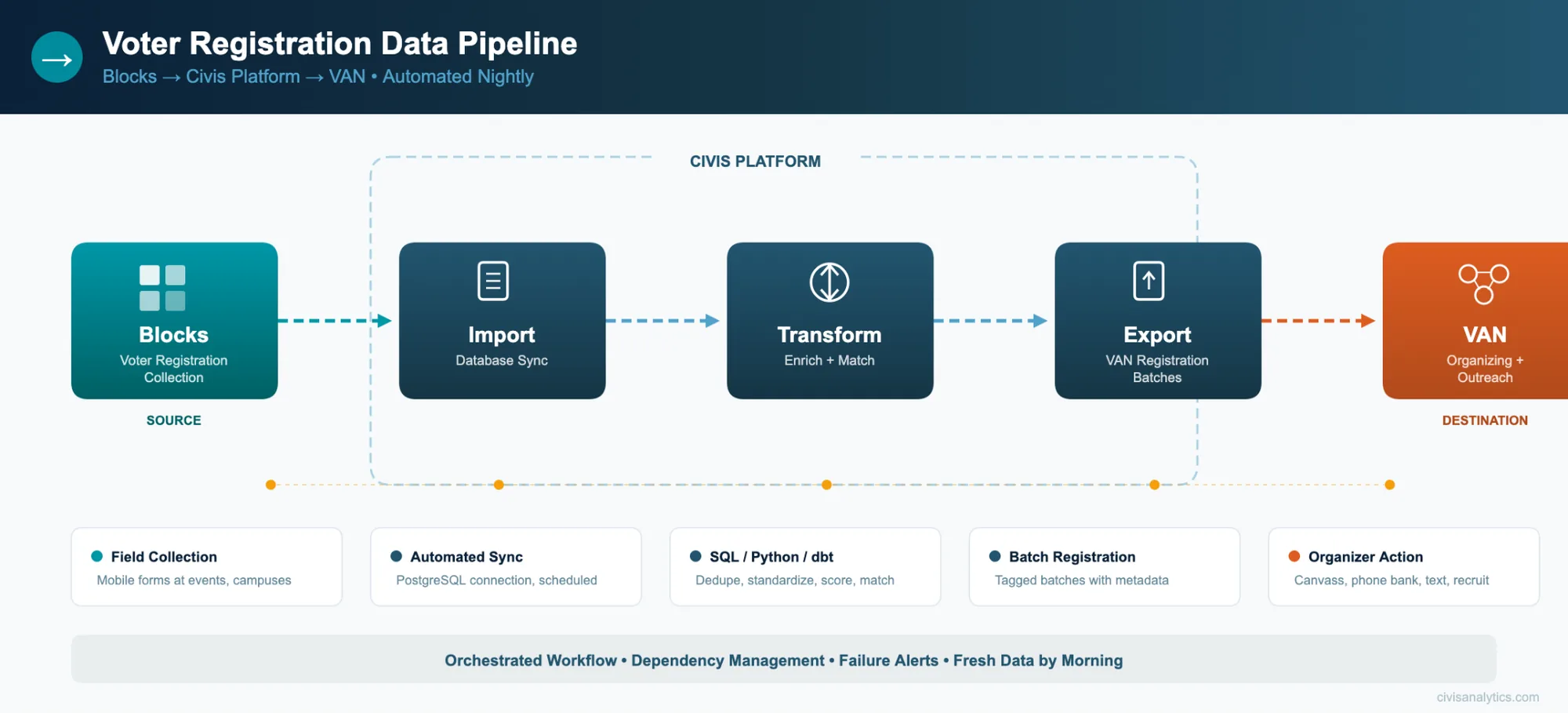
Civis Platform can make this workflow seamless. Let's walk through a practical example: importing voter registration data from Blocks, enriching it in your data warehouse, and loading it into VAN as voter registration batches ready for your organizers to act on.
The Tools
Blocks is a political advocacy software platform built for modern organizing. Among its core features is a voter registration tool that lets field teams collect and manage registrations from their phones. Blocks tracks every stage of the registration process, from the moment a form is collected through delivery for processing. Organizations get dynamic status reports, performance management, and delivery receipts for easy retrieval.
NGP VAN is the technology backbone for Democratic and progressive campaigns, nonprofits, unions, and PACs. VAN combines voter file access, organizing tools, and supporter data in one platform. When your field data lives in VAN's My Voters database, your organizers can use it for canvassing with MiniVAN, phone banking with OpenVPB, texting, and volunteer mobilization.
The challenge is connecting these two systems. Your field team collects registrations in Blocks, but your organizers need that data in VAN to build targeted universes and run outreach programs.
Setting Up the Import from Blocks
Start by configuring a database sync in Civis Platform that pulls new voter registration records from Blocks into your data warehouse. Blocks exposes its data through a PostgreSQL-compatible connection, which means you can use Civis's database sync capability to connect directly to their database and pull records into your warehouse on a schedule.
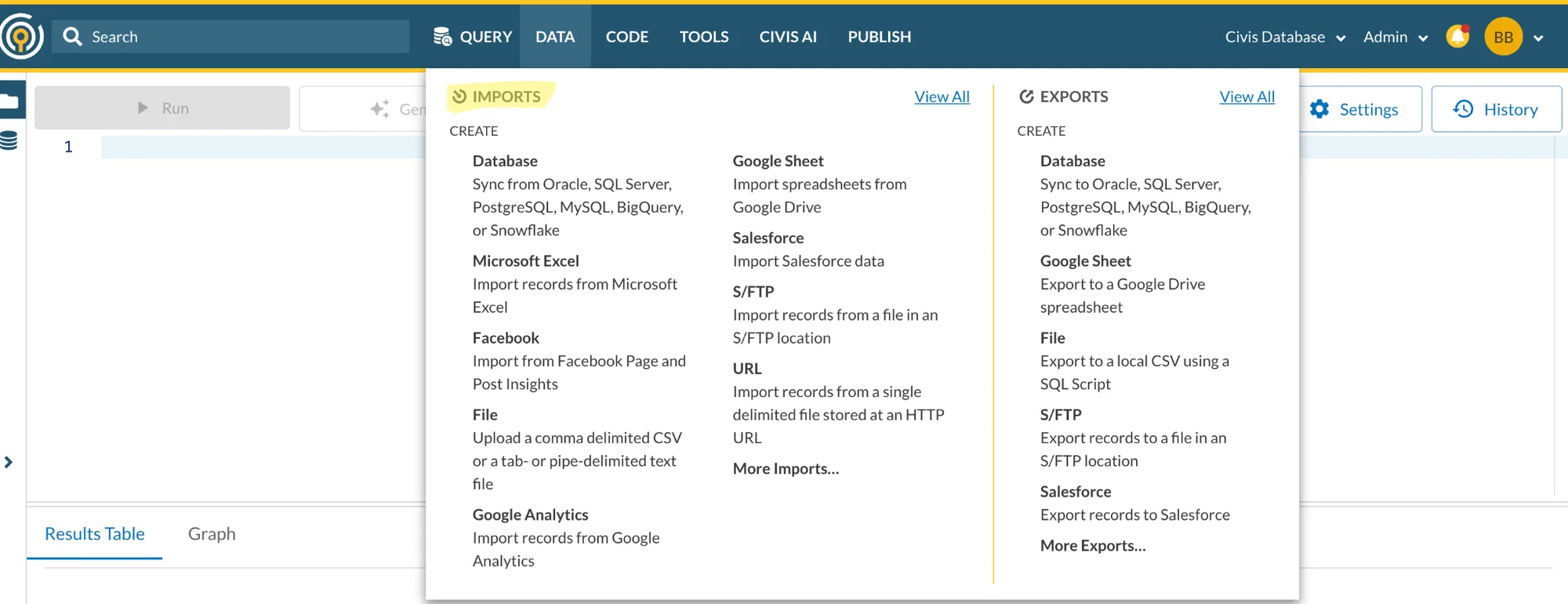
Navigate to the Data section and select Import, then choose Database Sync. Configure the connection to Blocks using the credentials they provide, select the tables containing your registration data, and set up your sync schedule. During peak registration drives when your field teams might be collecting hundreds of forms per day, you may want to sync multiple times daily. Each record will include the registrant's contact information, collection date, canvasser who collected the form, and current processing status. You can filter to only pull records that have reached a certain status, like "delivered to county," if you only want confirmed registrations flowing into your organizing systems.
Once configured, this import runs automatically on your schedule. No manual exports, no file transfers, no forgotten syncs.
Transforming and Enriching the Data
Raw registration data needs cleanup before it's useful for organizing. In Civis, you can write SQL scripts, Python jobs, or dbt models to transform your Blocks data.
Common transformations include:
Address standardization. Registrants write addresses in all sorts of formats. Standardize to USPS format so your data matches cleanly against the voter file and other sources.
Deduplication. If someone registered multiple times (it happens), flag or merge those records before they create confusion downstream.
Matching to your existing universe. Use Enhanced Identity Resolution to match new registrations against your existing supporter database. Did this person donate last year? Did they sign a petition? Append that history so organizers have the full picture.
Appending voter file data. Match against the voter file to pull in voting history, demographics, and any predictive scores you've built. A newly registered voter with a high support score should probably get prioritized for outreach.
Source tagging. Add fields that identify where and when this registration was collected, which canvasser collected it, and what program it was part of. This helps you measure program effectiveness later.
Build these transformations into a script or dbt model that runs after each import. Your raw Blocks data goes in, and clean, enriched, matched records come out.
Exporting to VAN as Voter Registration Batches
With your data cleaned and enriched, set up an export to load records into VAN. Civis supports the voter registration export mode specifically designed for this workflow, which creates voter registration batches in VAN that package your records with tracking metadata.
Navigate to the Data section, select Export, and choose the NGP VAN connector. Select "voter registrations" as your export mode, which will load records into VAN's voter registration system where they can be compared and added to the My Voters database.
You'll need to specify a batch_id that groups your registrations together for tracking. Many organizations use a naming convention that includes the source, program, and date, something like "blocks_campus_drive_20260915". This makes it easy to track which registrations came from which programs when you're evaluating effectiveness later.
Map your Civis fields to VAN's person fields: name, address, phone, email, and any other contact information you've collected. VAN will match these records against the voter file and existing records in your database.
Set this export to run after your transformation job completes. New registrations collected in Blocks yesterday will be cleaned, enriched, and sitting in VAN by the time your organizers start work today.
Orchestrating the Full Workflow
Chain your import, transformation, and export jobs together in a Civis workflow. The workflow ensures jobs run in the right order and handles dependencies automatically. If the Blocks import fails, the transformation won't run on stale data. If the transformation fails, bad data won't get pushed to VAN.
Set up alerts so you know immediately if something breaks. Your team wakes up to fresh data without lifting a finger, and you hear about problems before anyone notices downstream.
Why Timeliness Matters
During peak registration season, the difference between a one-day sync and a one-week sync is enormous. A voter who registered at a campus event on Monday is most engaged right then. By the time they show up in your VAN universe a week later, that enthusiasm has cooled. They've moved on to midterms, jobs, and life.
When your data flows nightly, your organizers can follow up within days. They can send a welcome text while the registration experience is still fresh. They can invite new registrants to upcoming events in their neighborhood. They can add high-propensity newly registered voters to canvass universes before Election Day.
Verifying Registrations Hit the Voter Rolls
Collecting a registration form is only half the battle. Organizations also need to verify that those registrations actually make it onto the voter rolls. Forms get lost, addresses get rejected, and county processing times vary widely.
With your registration data in Civis, you can match your collected registrations against updated voter file snapshots to see which ones have been processed. Build a report that flags registrations submitted more than 30 days ago that still don't appear on the voter file. Your team can then follow up with those individuals to troubleshoot problems before registration deadlines pass.
This closes the loop on your registration program and ensures the hard work of your field and digital teams actually translates into voters who can cast ballots in November.
Every voter registration your team collects should translate into real organizing power. Unified data, flowing automatically, makes that possible.
Getting Started
If you're already a Civis customer, you can start building this integration today. Navigate to the Imports section to configure your Blocks connection, and check out our reverse ELT documentation for loading voter registration batches to VAN. Our support team is happy to help you design a workflow that fits your organization's needs.
If your organization uses a different voter registration tool, or an emerging voter contact platform, we can support you there as well. Civis has existing database syncs to several other tools in the space, and we can build new integrations by request.
Not yet on Civis? We'd love to show you how Platform can unify your voter data and power your organizing programs. Reach out to schedule a demo.
Your field teams work hard to register every voter. Make sure that work counts.